ACCESSA · RURAL LOGISTICS HUB INITIATIVE

Rural America built the economy. Now it's being cut off from it. Our co-founders' lived experience — and a bold network built to fix it.
Introducing the Rural Logistics Hub Initiative (RLHI) — Accessa's network of smart locker hubs anchored in rural communities, built for the businesses and people left behind by modern logistics.
I know what it feels like to lose a sale because of a shipping label. Not because the product wasn't good enough — it was. Not because the price was wrong. Because the zip code said "rural Iowa," and the rate calculator punished me for it.
01 — The Problem Isn't Just Shipping. It's Survival.
Before co-founding Accessa, I ran a small e-commerce business and a gym in rural Iowa. Both depended on reliable, affordable logistics — inbound product, outbound orders, equipment deliveries. In a city, this is background noise. In rural America, it's a daily negotiation with forces that don't care about your margins.
FedEx and UPS coverage is thin outside metro corridors. Drop-off and pick-up points are sparse, often 20 to 40 miles away. And now, USPS — historically the backbone of rural delivery — is rolling back door-to-door service on an increasing number of rural routes. The safety net is unraveling.
The downstream effect? Rural businesses pay more per shipment. Rural customers wait longer and absorb higher shipping surcharges. Rural entrepreneurs compete at a structural disadvantage against urban and suburban counterparts who take two-day delivery for granted. It compounds every year, quietly hollowing out the economic fabric of small towns across America.
02 — The Wrong Question Has Been Asked for Too Long
For decades, the rural logistics conversation has orbited around carriers. Can we get FedEx to extend routes? Can USPS hold the line? Can Amazon build fulfillment centers in smaller markets? These are the wrong questions — they wait for someone else to solve the problem, and they center solutions designed for density in places that aren't dense.
The right question is this: What infrastructure can rural communities own, operate, and benefit from directly?
Centralized pickup and drop-off points aren't a new concept — they're common in European markets and emerging rapidly in urban cores through smart locker networks. But rural America has been systematically bypassed. Not because the model doesn't work — it works better here than almost anywhere else. But because no one built the network.
Until now.
03 — Smart Lockers Change the Economics Entirely
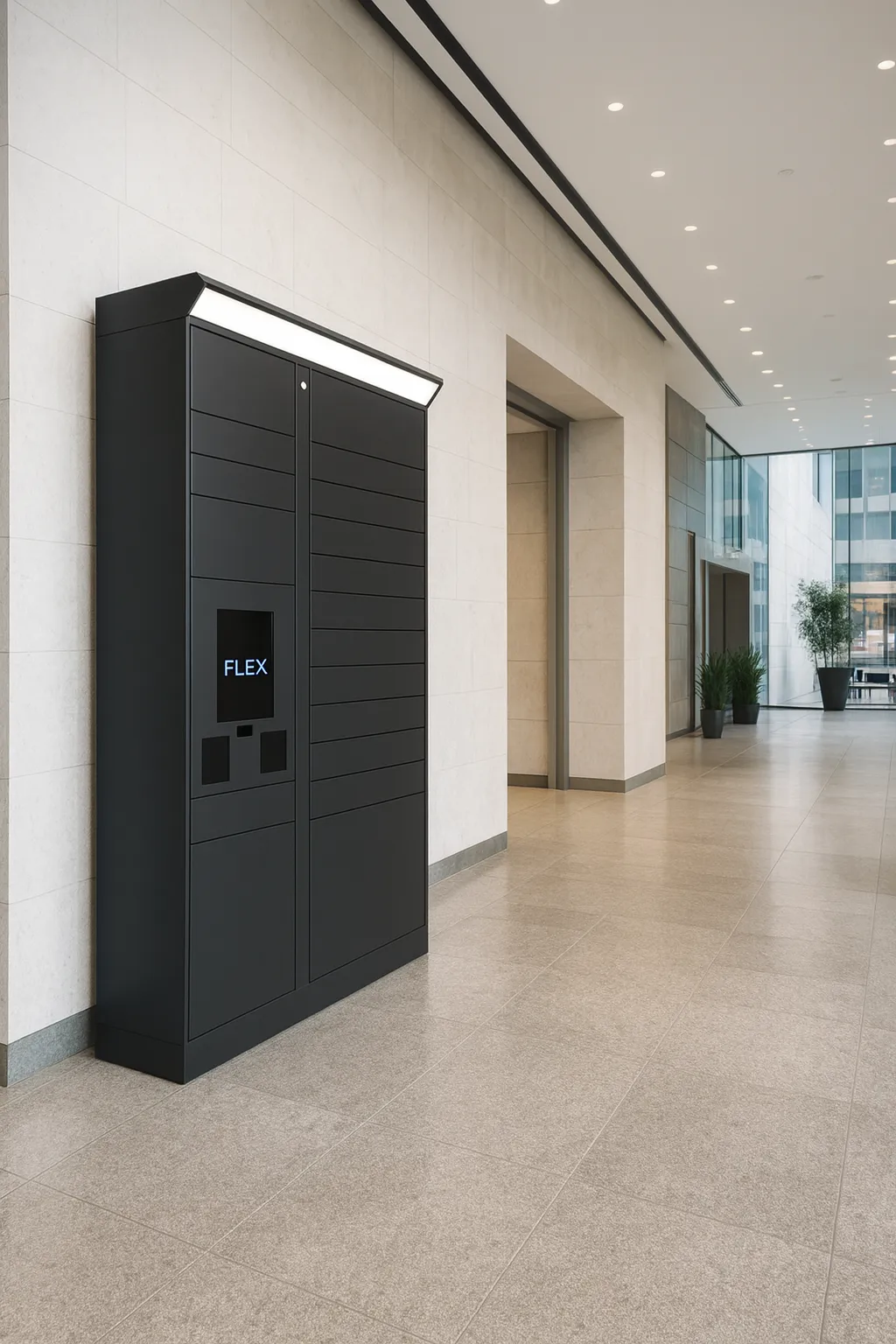
Here's what a rural smart locker hub actually does: it consolidates delivery density. Instead of a carrier making 30 individual stops across 15 rural miles — burning fuel, time, and per-stop cost — they make one stop at a hub. One scan. Done.
That consolidation translates directly into lower per-package rates. Carriers pass on efficiencies when volume concentrates. Businesses using the hub share those savings. Residents pick up packages on their own schedule — no missed deliveries, no porch theft, no driving 45 minutes to the nearest carrier facility. The locker works 24/7. It doesn't call in sick.
On the outbound side, a rural business owner — a custom furniture maker, an artisan food producer, a local retailer — can drop their orders at the hub at 6am before the workday starts. The carrier sweeps it at 9am. The package is moving. That's competitive parity with a seller in Chicago, achieved through infrastructure, not luck.
And the hub doesn't just serve e-commerce. A local hardware store can use it for click-and-collect overflow. A medical clinic can facilitate prescription pickup. A regional food co-op can coordinate farm-to-consumer order collection. The locker becomes local infrastructure — connective tissue for commerce that the community actually controls.
04 — Introducing the Rural Logistics Hub Initiative (RLHI)
The RLHI is Accessa's network-building answer to rural America's infrastructure deficit. It's built on four pillars:
Anchor Partner Model — We partner with established local businesses — co-ops, farm supply stores, community centers — to host locker hubs. They benefit directly, and the community benefits through the network.
Carrier-Neutral Access — RLHI hubs are carrier-neutral. USPS, FedEx, UPS, regional carriers, and local couriers can all access the network — driving competitive rates for rural senders and recipients alike.
Local Business Hub — Beyond parcel logistics, hubs serve as physical touchpoints for local commerce — click and collect, local delivery coordination, and B2B shipment staging.
Shared Network Economics — Every hub added to the RLHI network increases value for every other hub. More density means better carrier terms, more services, and more reasons for communities to engage.
05 — The Anchor Business Model: Why It Works
The RLHI doesn't drop a locker in a parking lot and hope for the best. It's built on anchor partnerships — relationships with established, trusted businesses who host and co-steward the hub location.
Why anchor partners? Because trust is local. A farmer will pick up a package at the Co-Op because they already go there twice a week. A family will collect a prescription at the pharmacy they've used for twenty years. The locker gains immediate utility because the anchor brings foot traffic, credibility, and community relevance that no amount of signage can manufacture.
In return, anchor partners gain a new value driver — increased foot traffic, revenue share from hub transactions, and a positioning advantage as a community infrastructure provider. They become more than a store. They become a node.
Ideal anchor partners include farm supply stores and co-ops, fuel and convenience locations, hardware and feed stores, and civic spaces like libraries and community centers — any established business with consistent community traffic and a stake in their town's economic health.
06 — This Is a Network Play, Not a Hardware Play
The locker is the hardware. The RLHI is the network. And networks compound.
The first hub in a rural county is useful. Five hubs across a county are transformative. Carriers route differently. Rates drop. Local businesses coordinate inventory across locations. Residents in the furthest corners of the county now have a hub within reasonable driving distance instead of a 40-mile trip to town.
Every node added multiplies value for every existing node. And unlike a data network, RLHI nodes create real physical value: jobs hosted, packages moved, businesses enabled, communities connected.
Rural America doesn't need charity logistics. It needs infrastructure with dignity — systems that treat small towns as valuable markets, not delivery afterthoughts.
07 — The Challenge We're Issuing to Rural Business Leaders
If you run a business in a rural community — a farm supply store, a co-op, a hardware shop, a community space — you already know this problem. You've watched customers drive past your location to get to the nearest UPS Store. You've absorbed the surcharges. You've heard from local entrepreneurs frustrated by costs that make online selling feel impossible.
The RLHI is asking you to be part of the solution. Not as a passive host — as an active anchor. A partner who gains real business value while building something that makes your entire community more economically competitive.
We're not coming in with a pitch about disruption. We're coming in with a question:
What would it mean for your community if every local business could ship competitively? If every resident could receive packages reliably? If your location became the hub that made it possible?
That's the Rural Logistics Hub Initiative. And the first anchor partnerships are forming now.
Ready to become an anchor partner?
RLHI anchor partnerships are now open. If you're a rural business owner, co-op manager, or community organization leader, let's talk about what a hub at your location could mean for your business and your community.
send us a message!
About Accessa: Accessa is a smart locker and connected hardware platform purpose-built for communities, enterprises, and multi-residential environments. The Rural Logistics Hub Initiative is Accessa's flagship community infrastructure program, partnering with anchor businesses to build carrier-neutral, community-owned logistics networks in underserved rural markets.