
The Last Main Street: Why AI Will Finish What Walmart Started
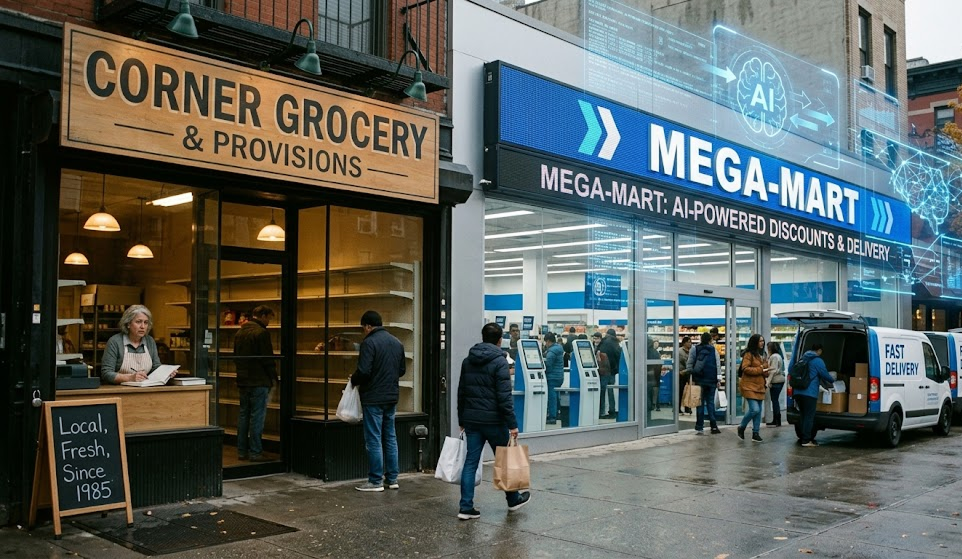
Four decades of big-box dominance eroded the American small business. Artificial intelligence is about to make that damage look like a warm-up. But for the business owners paying attention, the window to fight back is still open.
I have always enjoyed the small locally owned businesses from retail, B2B, etc. I once owned a business on one street in Pocahontas, my hometown. I know what those streets look, smell, and feel like. I know the hardware store owner who knows your name, the bakery that's been in the same family for three generations, and the local clothing boutique that stays open late during the holidays because the owner lives upstairs.
I also watched those streets hollow out. And I've been watching the numbers long enough to know we're now entering the most dangerous chapter yet.
50.7% - SMB share of U.S. GDP in the late 1990s, now fallen to 43.5%
15,000 - Retail stores expected to close in 2025, the worst year on record
2.5× - The annual GDP growth rate of large businesses vs. small businesses since 1998
Act One: The Walmart Era
The modern assault on small business began in 1962 , the same year Walmart, Target, and Kmart all opened their first stores. From that moment forward, big-box retail began quietly rewriting the economics of every town in America.
The playbook was devastatingly simple: locate at a highway interchange, offer prices no independent retailer could match, and capture enough volume to make the math impossible for anyone nearby. Within a generation, the factories of scale turned what had been neighborhood commercial ecosystems into commodity clearinghouses.
"In dozens of tiny Southern communities, Walmart opened stores, often destroying locally owned businesses in the process. Then it packed up and left. The nearest grocery store and pharmacy became a 50-minute round-trip drive."
— Institute for Local Self-Reliance
The SBA's own research identifies the rise of big-box retail as one of the primary structural factors behind the declining share of GDP generated by small businesses. From 1998 to 2014, that share dropped from 48% to 43.5%. Over the same stretch, large businesses grew their GDP contribution at nearly double the pace of small ones, 2.5% annually versus 1.4%.
This wasn't a recession effect. Researchers were explicit: it was structural. The rules of competition had been rewritten, and small businesses were playing by the old rules.
Act Two: E-commerce, and the Slow Bleed Continues
Just as main streets began adapting to big-box competition, the internet arrived and erased whatever remained of the geographic moat that had once protected local businesses. Amazon didn't just compete; it eliminated entire categories. Bookstores, music shops, electronics retailers, toy stores, gone, or functionally gone, within a decade.
During the pandemic, the divergence became grotesque. While small business sales fell to negative 28%, Walmart's online sales surged 97% in a single quarter. Target called its results "exceptional by virtually any measure." Meanwhile, by August 2020, roughly 155,000 businesses had shuttered, with an estimated 91,000 permanently closed.
By the numbers: Large businesses now employ the same 46.5% of the private-sector workforce that small businesses do — but they generate that output from a fraction of the entity count. Of the 32.6 million businesses in the U.S., just 20,868 have 500 or more employees. Yet their economic gravity keeps pulling the center of mass away from Main Street.
And now 2025 is shaping up to be the worst year for retail closures in modern history, with analysts projecting 15,000 store closings, a number that would eclipse even the pandemic peak.
Act Three: The AI Advantage Gap — and Why This Time Is Different
Here is the hard truth that most small business owners have not yet internalized: every competitive disadvantage that Walmart's scale created over the past 40 years is about to be replicated and amplified by artificial intelligence. And this time, the gap won't close with time or grit.
The cost problem
Fortune 500 companies are deploying AI-driven operations at scale, automating logistics, customer service, procurement, and marketing in ways that reduce headcount costs by 30–50%. A small business owner working 70 hours a week cannot manually compete with an algorithm running 24/7.
The speed problem
Large enterprises can now test, iterate, and deploy new products, pricing strategies, and customer experiences in days. Small businesses, still reliant on spreadsheets and gut instinct, operate on a cycle measured in months.
The quality problem
AI-assisted content, customer support, and personalization is reaching parity with, and in many cases exceeding, what an underfunded SMB can produce. The differentiation that came from a "personal touch" is being systematized at enterprise scale.
The data problem
Big companies have years of behavioral data to train their AI models. A small retailer with three years of QuickBooks exports cannot compete with a corporation feeding millions of daily transactions into a predictive pricing engine.
Walmart didn't beat Main Street by being smarter. It beat Main Street by having structural advantages that were simply impossible to overcome with effort alone. AI is that same kind of structural advantage — but deployed at a speed and breadth that makes the Walmart era look like a gentlemen's disagreement.
"The question isn't whether AI will reshape the competitive landscape for small businesses. It already is. The question is whether you're going to be on the receiving end of that disruption or the one delivering it."
But There Is a Window. And It's Closing Fast.
Here is what the doom narrative misses: AI is not inherently a large-company advantage. It is currently a large-company advantage because large companies were first to deploy it at scale, and because the tools required to build AI-powered products have historically required technical teams, engineering resources, and seven-figure infrastructure budgets.
That assumption is breaking down. Fast.
The same technological compression that gave us smartphones, cloud computing, and e-commerce democratization is now happening to AI. The gap between what an enterprise can deploy and what a scrappy, motivated small business can deploy is narrowing, but only for the businesses that move now, before the window closes entirely.
I have long believed in the resilience and ingenuity of small business owners. I've seen it up close in towns like Pocahontas, and in hundreds of conversations with operators who built something meaningful with their own hands. The problem has never been work ethic or creativity. The problem has been access to tools.
That is exactly the problem we are solving.
Introducing Accessa Lab
Built for the small business owner who refuses to be outrun.
Accessa Lab was built on a single conviction: the competitive advantages of AI should not be reserved for companies with IT departments. We enable SMB teams, with zero technical resources — to launch AI-powered products internally, building the operational efficiencies and customer experience capabilities that were previously available only to the Fortune 500.
No developers. No six-month implementation timelines. No enterprise contracts written to confuse you into paying more than you should.
Just the tools to automate what drains your time, sharpen how you serve your customers, and build a business that doesn't just survive the AI era, but uses it as the greatest unfair advantage a small business has ever had.
Walmart won the last war because small businesses couldn't match its infrastructure. You don't have to make the same mistake twice. The infrastructure is now available to you. The question is who picks it up first.