Why Accessa Phone Lockers Are a Smarter Investment for Schools Than Yonder Pouches
As more schools adopt strict no-phone policies to improve focus, reduce distractions, and support student well-being, administrators face a critical decision:
Why Accessa Phone Lockers Are a Smarter Investment for Schools Than Yonder Pouches
As more schools adopt strict no-phone policies to improve focus, reduce distractions, and support student well-being, administrators face a critical decision:
How should we manage student phones during the school day?
Two common approaches dominate the conversation:
- Individual locking pouches (like Yonder)
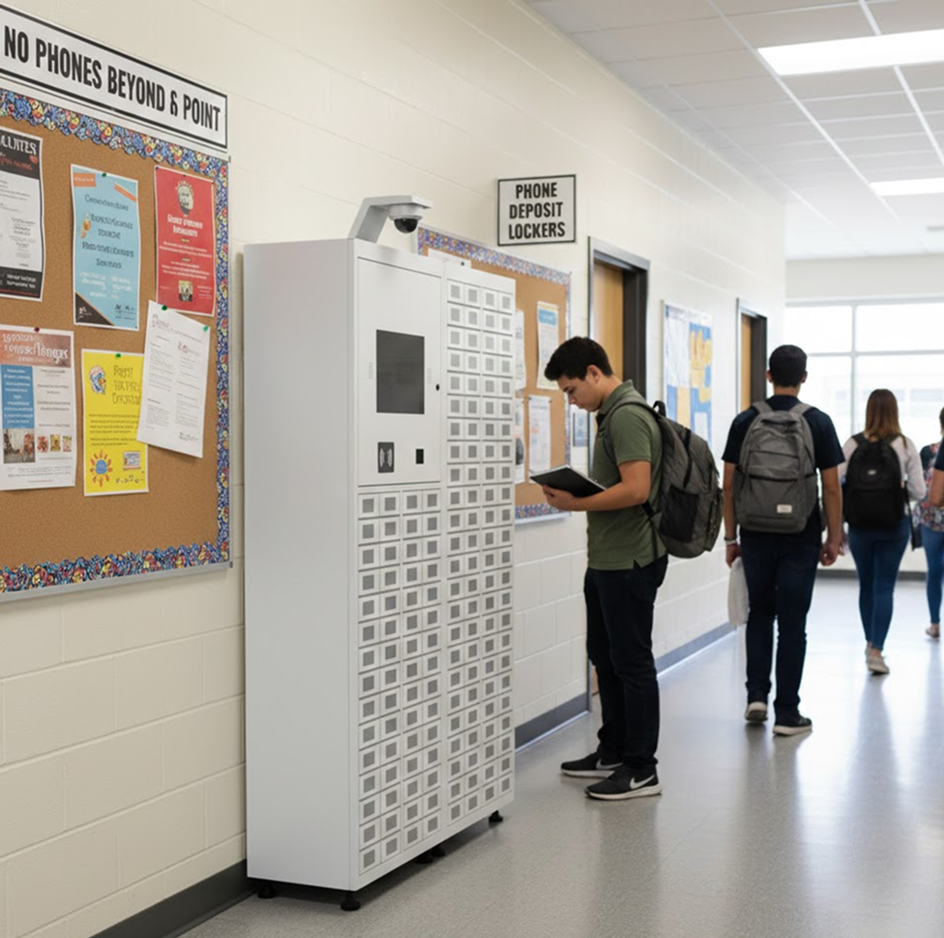
- Centralized phone locker systems (like Accessa)
While both aim to reduce phone access during school hours, the long-term value and operational impact are dramatically different.
Here’s why Accessa’s phone lockers are the better investment for schools.
1. The Cost Math Favors Lockers — Quickly
At first glance, pouches may seem like the cheaper option. But when you look closer, the economics tell a different story.
It only takes 2.5 Yonder pouches to equal the cost of one Accessa locker door.
That means:
- If a pouch is lost, damaged, or needs replacement, costs accumulate quickly.
- With normal wear and tear, pouch replacement becomes an ongoing budget line item.
- Schools must continuously reorder and manage inventory.
By contrast:
- A locker door is a durable, long-term asset.
- There’s no recurring per-student hardware replacement.
- The system remains in place year after year.
Instead of paying repeatedly for consumable hardware, schools invest once in infrastructure that lasts.
Accessa lockers are a capital investment. Pouches are a recurring expense.
2. Stronger Security and Accountability
Pouches rely heavily on compliance and supervision:
- Students carry their locked phones throughout the day.
- Pouches can be damaged, tampered with, or forgotten.
- Enforcement depends on staff monitoring.
Accessa lockers provide a more controlled solution:
- Phones are physically secured in fixed locations.
- Access is managed through secure authentication methods.
- Administrators can track usage and access logs.
- Each phone is assigned to a specific locker door.
This creates:
- Clear accountability
- Reduced tampering
- Improved enforcement consistency
- Better compliance with school policy
When phones are stored centrally instead of carried around campus, enforcement becomes simpler and more reliable.
3. Tracking and Visibility for Administrators
One of the biggest limitations of pouch systems is the lack of visibility.
With pouches:
- There’s no centralized tracking.
- No real-time insight into usage.
- Limited reporting capabilities.
Accessa lockers provide:
- Digital tracking of access events
- Administrative oversight
- Usage reporting
- Time-stamped data for security or policy reviews
For schools that prioritize safety and documentation, this level of visibility is a major advantage.
4. Better Experience for Students and Staff
Phone policies are only successful if they’re easy to enforce and operationally manageable.
Pouches create friction:
- Manual locking/unlocking processes
- End-of-day bottlenecks
- Staff time spent managing distribution and collection
- Ongoing pouch inspections
Accessa lockers streamline the process:
- Structured drop-off and pickup
- Organized storage
- Reduced chaos at dismissal
- Minimal daily staff intervention once implemented
Instead of managing thousands of individual items, schools manage a secure system.
5. Long-Term Durability vs. Consumable Hardware
Pouches are wearable products. Over time, they:
- Tear
- Break
- Lose locking integrity
- Need replacement
Lockers are designed for institutional use:
- Built for durability
- Mounted securely
- Resistant to daily wear and tear
- Designed for multi-year use
When evaluating a multi-year phone policy, infrastructure matters.
6. A Scalable Solution
As enrollment grows or policies expand, pouch systems scale linearly — meaning every new student requires another unit purchased.
With locker systems:
- Expansion is modular.
- Capacity can be added strategically.
- The system integrates into school facilities planning.
This makes lockers far more aligned with long-term campus planning.
The Bottom Line
Schools adopting no-phone policies are making a long-term commitment to student focus and academic integrity.
The question isn’t just, “What’s the cheapest way to start?”
It’s:
“What’s the smartest way to sustain this policy for years?”
With stronger security, digital tracking, improved durability, and a break-even cost at just 2.5 pouches per locker door, Accessa phone lockers aren’t just an alternative to Yonder — they’re a smarter long-term investment.
If your school is serious about enforcing a no-phone policy effectively and sustainably, infrastructure beats consumables every time.